Introduction:
When the Applause Fades, Ronnie Dunn Finds Another Way to Tell America’s Story
Millions know Ronnie Dunn as the towering voice behind Brooks & Dunn—the singer who could turn heartbreak into something unforgettable and make an arena erupt with a single chorus. His music became woven into American life, carrying generations through love, loss, long highways, and second chances. Yet beyond the stage lights lies a quieter side of Ronnie that even devoted fans may never have discovered.
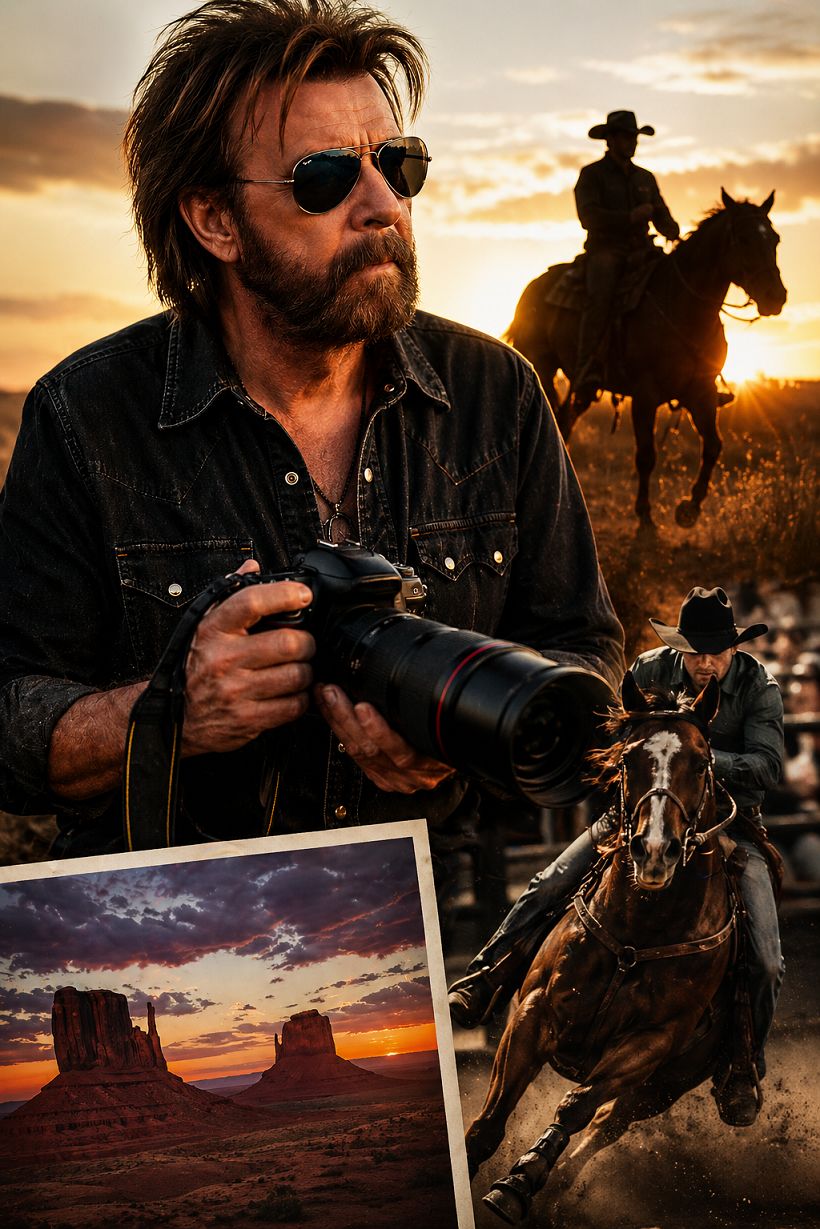
When the microphone is lowered and the crowd has gone home, Ronnie Dunn often reaches for a camera.
Photography is not simply a passing hobby for him. Ronnie once revealed that capturing a powerful image can bring him nearly as much satisfaction as performing before thousands of fans. Coming from a man whose life has been defined by music, that admission is striking. It suggests that behind one of country music’s most recognizable voices is an artist who still feels compelled to search, observe, and tell stories.
Only now, he tells them without singing a word.
His subjects are rarely glamorous celebrity portraits. Ronnie is drawn instead to the raw beauty of rodeos, horses, weathered cowboys, Western landscapes, and fleeting moments filled with movement and emotion. Through his lens, dust rising beneath a horse’s hooves or determination carved into a rider’s face becomes its own kind of country song.
That connection feels deeply personal. Born in Texas, Ronnie has always carried the spirit of the American West in his music. His songs speak of working people, broken hearts, open roads, hard-earned freedom, and the courage to keep going. Photography allows him to preserve those same truths in another form—replacing verses and melodies with light, shadow, and a perfectly timed shutter.
His work eventually earned recognition beyond the curiosity surrounding a famous musician. A collection of Ronnie’s rodeo photography was displayed at the Cheyenne Frontier Days Old West Museum, showing that his images could stand on their own artistic merit. He was not merely a celebrity holding a camera; he had become a serious visual storyteller.
Perhaps the most moving part of this hidden chapter is what it reveals about growing older. Ronnie had already achieved the dreams most musicians spend their lives chasing: hit records, packed arenas, major awards, and a permanent place in country music history. He could have stopped searching for new creative territory.
Instead, he remained curious.
Photography requires patience. It asks a person to slow down, notice what others overlook, and recognize beauty before it disappears. In an industry built on noise and applause, the camera may have given Ronnie something the stage could not: silence, reflection, and the freedom to see the world differently.
Ronnie Dunn’s story reminds us that passion does not retire when one chapter ends. Sometimes the spotlight grows quieter only because another kind of light is waiting to be discovered.
Did you know about Ronnie’s remarkable photography—and have you ever found a new passion later in life? Share this story with someone who needs reminding that it is never too late to begin again.
Video: