Intrduction:
They Could Limit the Camera, but Not His Charm: Why Elvis Presley’s “Don’t Be Cruel” Still Captivates
Some performances survive as historical footage. Others make the years disappear. Elvis Presley’s January 6, 1957, performance of “Don’t Be Cruel” on The Ed Sullivan Show belongs to that second category. Watch it today, and the distance between a black-and-white television studio and your own living room suddenly feels surprisingly small.
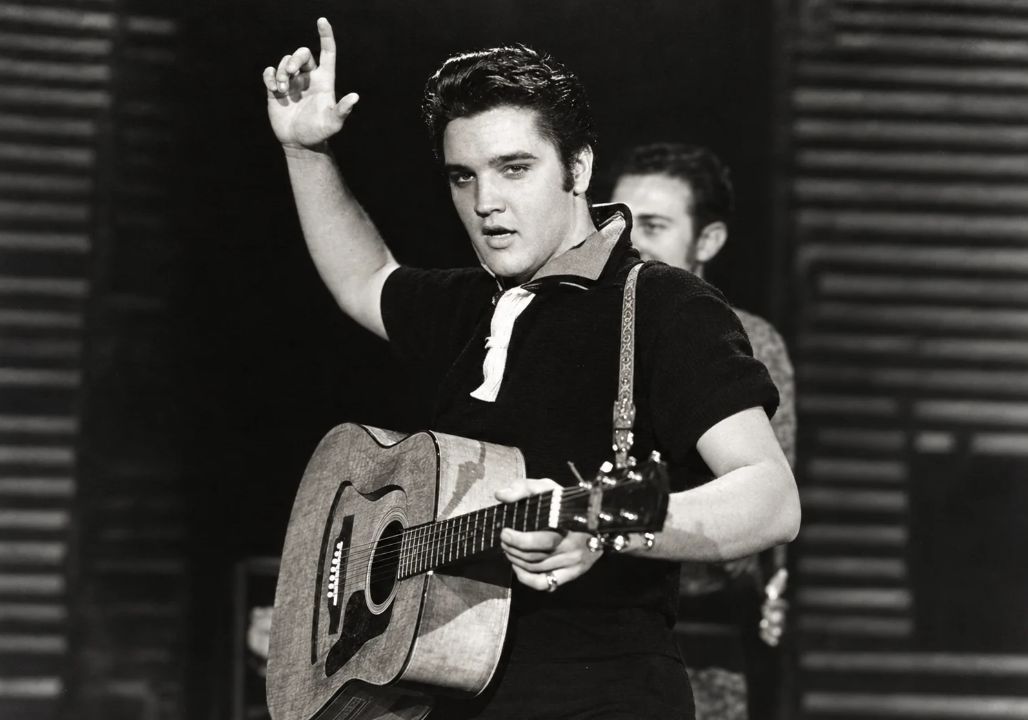
This was Elvis’s third and final appearance on Sullivan’s program. His popularity had brought excitement, but also fierce criticism from those who considered his movements inappropriate. For this broadcast, CBS required the cameras to show him from the waist up. Even within that restricted frame, his personality proved impossible to contain. Ed Sullivan Show
The appeal begins with his voice. There is warmth beneath the confidence, a lightness in the phrasing that makes the song feel like a conversation. He gives the melody room to bounce, balancing romantic pleading with playful assurance. The effect is inviting: you hear someone asking for affection while making it almost impossible not to smile.
Then comes the expression—the hint of amusement, the easy charm, the impression that he understands exactly why the audience is excited. His presence gives the performance a wonderful tension between control and spontaneity. You keep watching because even a small change in his face can feel like an event.
The song itself deserves equal credit. Recorded in New York on July 2, 1956, “Don’t Be Cruel” had already become part of Elvis’s remarkable breakthrough before this television appearance. Its compact structure and instantly recognizable melody gave him a perfect vehicle for connecting with listeners. Elvis Presley Official Site
Behind that success stood songwriter Otis Blackwell, whose demo helped shape Elvis’s interpretation. The Blues Foundation notes that Presley’s recording closely followed Blackwell’s singing and became a number-one single in 1956. Remembering that contribution deepens our appreciation of the performance: its magic grew from both inspired songwriting and a singer who could carry it into millions of hearts. Blues Foundation
The broadcast also offered a revealing human moment. At the end of Elvis’s appearance, Sullivan publicly praised his character and professionalism. Against the surrounding controversy, that endorsement gave viewers another way to see the young performer: as a courteous guest navigating extraordinary attention.
Perhaps that combination explains the clip’s lasting emotional pull. For longtime fans, it can recall family televisions, favorite records, and the excitement of discovering music that felt entirely their own. For younger viewers, the attraction needs no personal memory. The rhythm remains buoyant, the voice distinctive, and the pleasure immediate.
Watch “Don’t Be Cruel” again, and notice how quickly history becomes something personal. Before you finish thinking about its place in rock ’n’ roll, you may already be smiling.
What returns first for you—the melody, a memory, or the feeling Elvis could create with one look?